January 28, 2026
Bringing a physical product to market is a creative, technical, and deeply human journey. It is where vision meets reality and where ideas are shaped, challenged, refined, and ultimately transformed into something people can hold, use, and trust.
The most successful products do not happen by accident. They are built through a deliberate process that balances creativity with discipline, imagination with execution, and ambition with real-world constraints. At Enopto Design, we approach product development as a progression of phases, each designed to reduce uncertainty, build confidence, and prepare the next step for success.
Strategy is not a separate exercise. It is woven through everything we do.
This is how we approach the complete consumer product development process.
Phase 1: Ideation — Shaping and Stress-Testing the Vision
Ideation is where direction is set and momentum begins. This phase is about exploration, alignment, and visualizing what could be before deeper commitments are made.
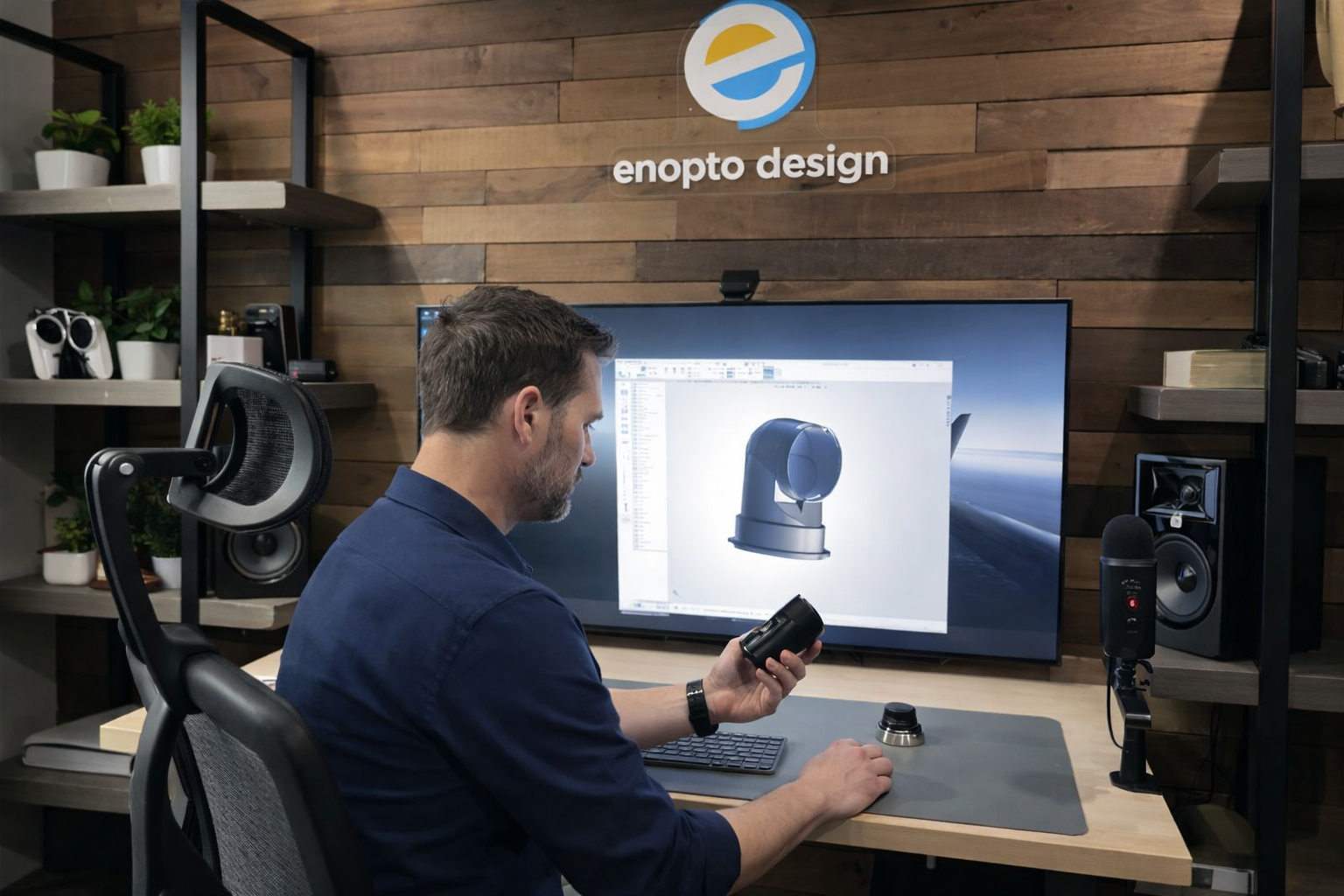
Sketching and early CAD play an important role here. These initial models are intentionally lightweight and visual. They are just detailed enough to explore form, scale, interaction, and intent while remaining flexible enough to evolve. This allows everyone involved to see the idea, react to it, and engage in meaningful discussion early.
Ideation at Enopto is not only about imagining possibilities. It is also about pressure testing convictions.
Projects often arrive with strong beliefs about how something should work, look, or be built. That confidence is valuable, but it deserves scrutiny. Through peer review, technical discussion, and market-informed questioning, we examine assumptions carefully and respectfully. When cracks appear, we do not treat them as failures. We treat them as opportunities to reinforce the direction or strengthen it in smarter ways.
Strategy quietly supports this process. It helps align creative exploration with user needs, business goals, and long-term feasibility without overpowering ideation itself. This is where we help clients navigate early tradeoffs like feature scope versus timeline, or market positioning versus manufacturing complexity.
By the end of Phase 1, the vision is no longer just exciting. It is grounded, aligned, and ready to move forward with purpose
Phase 2: Design & Engineering — Crafting a System Built to Succeed
Design and engineering is where experience truly shows.
With a pressure-tested vision in place, this phase focuses on turning intent into a system that performs as expected, looks and feels right, and can ultimately be manufactured efficiently and reliably.
Here, CAD evolves from visualization into precision. Parts, assemblies, and interfaces are designed with a deep understanding of how real materials behave, how processes introduce variation, and how small decisions compound once production begins.
Design for Manufacturing and Assembly is applied early and intentionally. We draw on decades of system-level design experience to avoid common pitfalls that surface later as warped parts, surface defects, tolerance stack-ups, or assembly challenges. Often, the outcome is simplicity: fewer parts, cleaner interfaces, and designs that are easier to build, inspect, and scale.
There is also an element of craft in this phase. Engineering excellence alone is not enough. Form, proportion, and interaction matter. We balance technical rigor with aesthetic intent and refine how the product communicates quality before it ever reaches production.
Selective early builds and interface mockups may be used to validate fit, motion, ergonomics, and integration assumptions. This ensures that digital decisions translate cleanly into the physical world.
By the end of this phase, the product is no longer just defined. It is thoughtfully composed and ready to be challenged.
Phase 3: Prototyping — Where Ideas Become Real
Prototyping is where everything changes.
There is nothing like holding your product for the first time. Until that moment, everything is theoretical. Screens, models, and assumptions dominate the conversation. Prototyping introduces weight, texture, balance, sound, and behavior. You often learn more in minutes than weeks of discussion could ever reveal.
At Enopto, prototyping is about breaking things on purpose.
We build to fail early, honestly, and constructively. We push products beyond how they are meant to be used so we can understand how they behave, how users interact with them, and where weaknesses exist. Failure here is not a setback. It is fuel that provides data we can act on while change is still fast and affordable.
This phase is deeply human. Watching someone interact with a prototype reveals friction that no CAD model can predict. Handling parts exposes issues of comfort, stiffness, or balance that numbers alone cannot capture. These moments unlock opportunities to improve performance, usability, and clarity.
Prototyping is also where manufacturing reality enters in a meaningful way. We explore different processes and often involve potential production manufacturers directly in prototype builds. This allows us to pressure test not just the product, but the partnership itself. Communication, responsiveness, and problem-solving matter here.
We approach this phase without ego. We do not assume we have everything figured out. We value insight from manufacturers who bring their own experience to the table. That exchange strengthens both the product and the process.
Believing a product is fully resolved in CAD before prototyping is a fool’s errand. Reality is richer and far more informative than theory.
Phase 4: Manufacturing — Executing with Intent and Protecting What Matters
Manufacturing is where preparation is put to work.
By this phase, the product has already been shaped, tested, and refined. Manufacturing is no longer about discovery. It is about execution with clarity, discipline, and intent.
For many clients, this represents the largest financial commitment of the entire journey. For founders, it may be the biggest investment they have ever made. For established teams, it is where forecasts, supply chains, and operations converge.
We take that responsibility seriously.
This is where manufacturing partners are finalized with intent. While collaboration often begins earlier, this phase is where decisions are locked in, agreements are formalized, and expectations are aligned across quality, cost, and schedule.
Manufacturers are selected based on capability, communication, consistency, and long-term fit, not just price. Processes are reviewed, documentation is finalized, and when appropriate, we are on site. We walk floors, review tooling, and ensure that what was designed and tested translates cleanly into production.
Manufacturing is dynamic. Tooling adjustments, material shifts, and supply chain realities are part of the landscape. We plan for that. Clear documentation, defined quality standards, and open communication allow issues to be addressed quickly and calmly.
For experienced teams, our goal is seamless execution. We support first article inspection, confirm readiness to scale, and hand over the keys cleanly once production is stable. From there, we remain a resource for reorders, revisions, and future iterations.
Manufacturing does not have to feel chaotic. With the right preparation and stewardship, it becomes predictable.
Strategy — The Thread That Connects It All
Strategy at Enopto is not a phase and it is not a presentation. It is embedded in how we work.
It shows up in the questions we ask, the assumptions we challenge, and the decisions we help our clients make when tradeoffs are unavoidable. Cost versus performance. Speed versus refinement. Complexity versus scalability. For one client, that might mean choosing between a premium molded enclosure and a faster-to-market machined solution. For another, it could be deciding whether to simplify a feature set to hit a launch window or delay to preserve the original vision.
For founders, strategy often means translating ambition into a realistic, executable path forward. For experienced teams, it means alignment and smooth integration with existing processes and goals.
This perspective comes from experience, not theory. It is why we review quotes carefully, help clients see around corners, and protect momentum without sacrificing clarity.
When applied well, strategy does not slow things down. It creates focus.
The Right Work, Done Together
Building a physical product takes courage. It takes belief in an idea, a willingness to commit real resources, and the patience to work through complexity without shortcuts.
It also takes energy, curiosity, and a genuine love for the process.
We do this work because we care deeply about seeing good ideas become real, well-built products. We love watching our clients grow, learn the process, gain confidence, make smarter decisions, and see their vision take shape in the world. That shared progress is the most rewarding part of what we do.
At Enopto, we do not just guide products forward. We coach, collaborate, and stay invested.
If you are ready to build something real, we would welcome the conversation.